What Are Isochronic Tones?
Isochronic tones are single tones that turn on and off at a very precise, evenly spaced rhythm. Think of them as a perfect auditory metronome for your brain. This distinct pulse creates a clear and powerful signal that the brain can easily follow.
- It’s a single tone: Unlike other methods, the sound is mixed before it reaches your ears, so you don’t need headphones.
- It uses sharp pulses: The sound goes from on to off instantly, creating a “brain beat” called a Cortical Evoked Response.
- The rhythm is key: The speed of these pulses is measured in Hertz (Hz), and this determines the tone’s effect.
How it works
Your brain has a natural tendency to synchronize its own electrical rhythms, or “brainwaves,” to the rhythm of external stimuli. This is called the Frequency Following Response. When you listen to an isochronic tone pulsing at 10 times per second (10 Hz), your brain gently adjusts its own activity to match that 10 Hz rhythm. By choosing a specific frequency, you can encourage your brain to enter a desired mental state, like focus or relaxation.
Creating the Optimal Listening Environment
To get the most out of your sessions, a little preparation goes a long way:
- Minimize Distractions: Find a quiet place where you won’t be interrupted.
- Get Comfortable: Sit or lie down in a comfortable position.
- Stay Hydrated: The brain is an electrical organ and works best when you’re well-hydrated.
- Be Patient: The effects can be subtle at first. Give yourself time to relax into the experience.
The Brainwave Spectrum: Matching Frequencies to Mental States
Different brainwave frequencies are associated with different states of consciousness. By understanding these states, you can begin to recognize the subtle shifts in your own consciousness throughout the day. Here’s a simple guide:
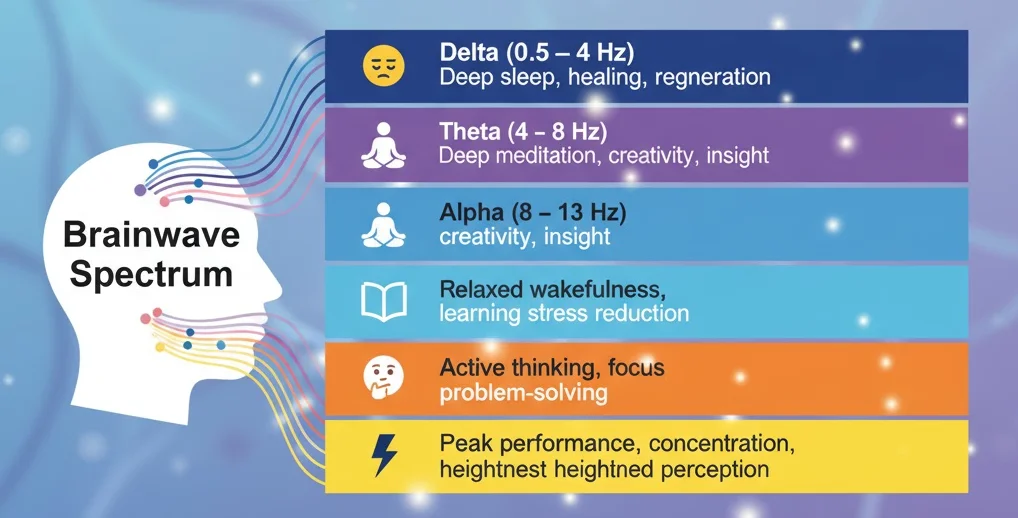
Think of your brain not as playing a single note, but as conducting a complex symphony of electrical activity. While all frequencies are always present, one will be dominant depending on what you are doing, thinking, or feeling.
Guide to the Isochronic Tone Generator Suite
Getting Started: Your First Session in 60 Seconds
The easiest way to begin is by using a built-in preset. Follow these three simple steps:
- Choose a Preset: Select a protocol from the dropdown menu that matches your goal, like “40 Hz – GENUS Protocol” for focus.
- Set the Duration: Use the slider to choose how long you want the session to be.
- Press Play: Click the large green play button. Remember to start with a low volume and adjust to a comfortable level.
Global Controls
These settings affect your entire session.
- Protocol Preset: This is your library of pre-configured, research-backed settings. Choosing one automatically sets up the generator for a specific goal. An info box will appear with details and a link to the source study, so you can see the science behind it.
- Session Duration: Sets the total length of your session. Pro-Tip: For lasting effects, sessions of 15-30 minutes are often recommended to give your brain time to synchronize.
- Master Volume: Controls the overall volume. Pro-Tip: The ideal volume is just loud enough to be clearly heard, but not so loud that it’s distracting. Comfort is key.
Crafting Your Sound with Layers
The Isochronic Tone Generator lets you play up to three distinct tones at the same time using layers. This allows you to create rich, complex soundscapes, such as a foundational Alpha tone for relaxation with a light Beta overtone for “focused calm.” Simply click the tabs (Tone 1, Tone 2, Tone 3) to switch between layers, and use the checkbox on each tab to turn a layer on or off.
Core Layer Controls
These settings define the sound of each individual tone layer.
- Rhythm Frequency (Hz): This is the heart of entrainment. It sets the number of pulses per second, which determines your target mental state (e.g., 10 Hz for relaxation).
- Pulse Sound: This is the voice of your tone. Choose “Square Wave” for a sharp, distinct pulse, “Sine Wave” for a softer, pure tone, or “Noise Burst” for a textured, static-like “shh” sound.
- Carrier Frequency (Hz): This is the audible pitch of your tone. Higher values create a higher-pitched sound. This setting is for your comfort and does not affect the entrainment frequency.
- Pulse Duration (ms): This is the sharpness of your tone. A short duration (e.g., 50ms) creates a sharp, clicky sound, while a longer duration (e.g., 200ms) creates a softer, fuller pulse.
Advanced Sound Design
These tools allow you to create dynamic, organic, and deeply immersive sessions. Click the “Advanced Layer Settings” bar to reveal them.
Ambience & Pink Noise
Enable this to add a continuous layer of pink noise, which sounds like a gentle waterfall. It’s excellent for masking distracting background sounds and can help enhance focus by making your brain more receptive to the rhythmic tones.
Per-Layer Modulations: Bringing Your Sound to Life
- Frequency Drift: Creates a hypnotic, gentle sweeping or “breathing” sensation by slowly oscillating the Rhythm Frequency up and down.
- Rhythmic Gating: Adds a musical tempo, grouping the fast pulses into slower, perceptible beats for a more calming and structured rhythm.
- Frequency Jitter: The “Humanizer.” This feature adds tiny, random variations to the rhythm, preventing listening fatigue and making the sound feel more organic and natural.
- Spatial Audio (Stereo Orbit): The immersion engine. This creates a 3D soundscape where the sound appears to circle around you, deepening your focus and preventing your brain from “tuning out” the stimulus.
Managing Your Creations: Saving & Loading Custom Presets
When you’ve designed a soundscape you love, click the “Save Custom” button to give it a name and save it to your personal library. You can then load it anytime from the “Protocol Preset” dropdown menu. To delete a preset, simply select it and click the “Delete” button.
The Deeper Science of Isochronic Entrainment
The Auditory Steady-State Response (ASSR): The Brain’s Rhythmic Lock-in
When your brain is presented with a rhythmic stimulus like an isochronic tone, it produces a measurable electrical response in your cortex that synchronizes with the stimulus. This is known as the Auditory Steady-State Response (ASSR). It is the direct, neurophysiological evidence that your brain is “locking in” to the rhythm you’re providing. This isn’t just a psychological effect; it’s a quantifiable electrical phenomenon that neuroscientists can observe on an EEG.
Brain Coherence and Functional Connectivity: How Tones Organize Your Brain’s Network
Effective entrainment goes beyond simply changing the speed of your brainwaves. It also influences how different parts of your brain communicate with each other. This is known as brain coherence or functional connectivity. When brain regions are in coherence, their electrical activity is synchronized, allowing for faster and more efficient information processing. By providing a common timing signal, isochronic tones can help organize and strengthen the communication pathways between different brain areas, improving the efficiency of the entire network.
Individual Alpha Frequency (IAF): The Future of Personalized Entrainment
While we classify brainwave bands into ranges (e.g., Alpha is 8-13 Hz), each individual has a unique “peak” frequency where their brain is most dominant within that band. This is especially true for the Alpha frequency. Your personal “Individual Alpha Frequency” (IAF) might be 9.5 Hz or 11.2 Hz, for example. For the most effective and personalized entrainment, advanced users can experiment to find their IAF and tune the generator to that specific frequency, potentially leading to significantly better results.
Harmonics & Subharmonics: The Hidden Frequencies in Every Pulse
The sharp, distinct pulse of an isochronic tone contains more than just its fundamental frequency. It also contains mathematical multiples of that frequency, known as harmonics. This means that a 10 Hz Alpha tone may also subtly influence brainwave activity at 20 Hz (Beta) and 30 Hz (Gamma). This complex response allows a single isochronic tone to stimulate a richer, broader spectrum of brain activity than just the target frequency alone, adding another layer of depth to your sessions.
Isochronic Presets: Recipes for Your Mind
While we encourage experimentation to find what works best for you, here are some powerful starting points based on common goals and scientific research. You can find these pre-configured in the “Protocol Preset” dropdown menu.
Protocols for Deep Focus & Study (Beta & Gamma)
These protocols use higher frequencies to promote alertness, concentration, and high-level thinking.
- 40 Hz – GENUS Protocol: Based on research into gamma frequencies for peak cognitive function. Excellent for intense problem-solving or pre-task priming.
- Sustained Focus Protocol: A steady 18 Hz Beta tone designed to help maintain concentration during long work or study sessions.
Protocols for Relaxation & Stress Reduction (Alpha)
These protocols use the alpha range to calm the nervous system and promote a state of relaxed awareness.
- Calm Mind Protocol: A gentle 10 Hz Alpha tone using a soft Sine Wave and a longer pulse duration to melt away stress.
Protocols for Meditation & Creativity (Theta)
These protocols use slower theta frequencies to quiet the conscious mind and access deeper states of creativity and insight.
- Creative Flow Protocol: Tuned to 7.83 Hz (the primary Schumann Resonance), this protocol is ideal for brainstorming, visualization, and meditative exploration.
Protocols for Sleep Support (Delta)
This protocol is designed to gently guide your brain from a waking state down into the frequencies of deep sleep.
- Sleep Induction Protocol: This session begins in the alpha range (8 Hz) and slowly ramps down to the delta range (2 Hz) over 20 minutes, mimicking the brain’s natural process of falling asleep.
Isochronic Tones vs. Binaural Beats
What is the Difference Between Binaural Beats and Isochronic Tones?
While both techniques aim to guide your brain toward specific states through rhythmic sound, the way they work is fundamentally different.
Binaural beats use two slightly different frequencies-one in each ear. Your brain perceives the difference between them as a third, internal beat. For example, if your left ear hears 200 Hz and your right ear hears 210 Hz, your brain produces a 10 Hz beat. This subtle effect requires stereo headphones, as each ear must receive its own signal.
Isochronic tones, on the other hand, use a single tone that switches on and off rapidly in time. The beat is real, not perceived, and it works even through normal speakers. Because the pulses are sharp and precise, the brain locks onto them more directly. This makes isochronic tones generally stronger and more efficient at inducing a Frequency Following Response.
In short:
- Binaural beats work through the brain’s internal perception of phase differences.
- Isochronic tones work through direct rhythmic stimulation of the auditory cortex.
For most users, isochronic tones produce faster, more reliable entrainment-especially in open environments where headphone use is not ideal.
Isochronic Tones for Sleep
Isochronic tones can gently guide your brain from wakefulness into the deep, restorative states associated with sleep. During the day, your brain typically operates in faster Beta and Gamma frequencies. As you prepare for rest, it naturally slows into Alpha (8-13 Hz), then Theta (4-8 Hz), and finally Delta (0.5-4 Hz) during deep sleep.
A well-designed sleep session mirrors this descent. For example, the Sleep Induction Protocol begins around 8 Hz and gradually drifts downward to 2 Hz over the course of 20-30 minutes, creating a smooth, natural transition into rest.
Tips for best results:
- Use headphones or low-level speakers in a quiet, dimly lit room.
- Avoid blue light from screens before and during the session.
- Pair with slow, steady breathing to reinforce parasympathetic activation.
Many users report falling asleep before the session ends, and over time, they find it easier to return to sleep after waking in the night. Regular use can help train your nervous system to associate these rhythms with relaxation and rest.
Isochronic Tones for Focus
Do Isochronic Tones Work for ADHD?
Focus-related protocols use Beta (14-30 Hz) and Gamma (30-50 Hz) frequencies to enhance alertness, attention, and working memory. These ranges are associated with active problem-solving, sustained concentration, and peak cognitive engagement.
The 40 Hz GENUS Protocol, in particular, has been linked in research to improved network synchronization between brain regions involved in learning and sensory integration. Users often describe the sensation as “mental brightness”-a calm, clear focus without overstimulation.
For those with ADHD or attention difficulties, isochronic tones may serve as a supportive tool. While they are not a substitute for professional treatment, early studies and anecdotal reports suggest they can help the brain maintain steady attentional rhythms, reducing restlessness and improving task persistence. When combined with mindfulness or deep breathing, the effect can be even stronger.
For best results, short sessions of 10-20 minutes before studying or work tasks can help prime the brain for sustained focus.
Isochronic Tone Benefits
Do Isochronic Tones Really Work?
The effectiveness of isochronic tones rests on well-established neuroscience: the Auditory Steady-State Response and Frequency Following Response. These are measurable phenomena where brain electrical activity synchronizes with rhythmic auditory stimuli.
Research-backed benefits include:
- Enhanced cognitive performance and memory during Beta/Gamma entrainment
- Reduced stress and anxiety during Alpha entrainment
- Improved sleep onset and quality through Theta/Delta sessions
- Increased mood stability and resilience via long-term coherence training
However, as with meditation or exercise, the key is consistency. Most users notice subtle effects at first-such as smoother transitions between mental states or quicker recovery from stress-which grow more pronounced with regular use. The brain adapts to rhythmic conditioning over time, deepening its capacity for self-regulation and balance. Our isochronic tone generator is a best in class tool, but it is not a medical device, or substitute for proper medical care.
How Long Should You Listen to Isochronic Tones?
Optimal session length depends on your goal and experience level.
- Beginners: Start with 10-15 minutes once per day.
- Intermediate users: Increase to 20-30 minutes, focusing on specific states e.g., focus in the morning, relaxation in the evening.
- Advanced entrainment practice: Sessions up to 60 minutes can produce deep, sustained coherence for meditation or sleep.
More is not necessarily better. The aim is to entrain, not overwhelm. Once your brain locks into the target frequency, additional time primarily strengthens stability rather than depth.
For best results, use the tones at consistent times each day, ideally in a calm setting where your mind can fully relax into the rhythm. Over time, you may find your brain naturally recalls these states even without audio-an indicator of successful entrainment and integration.
Safety, Best Practices, and Maximizing Your Results
The Golden Rule: Start With Low Volume
Your hearing and comfort are paramount. Always begin any session with the volume set to a low level. Once the sound begins, you can gradually increase it to a comfortable volume where the pulses are clear but not intrusive. Listening at excessively high volumes provides no extra benefit and can be harmful to your hearing.
Who Should Exercise Caution? (Disclaimer)
This is an educational and experimental tool, not a medical device. It is not intended to diagnose, treat, or cure any disease. Please consult a qualified healthcare professional before using brainwave entrainment if you:
- Have epilepsy or are prone to seizures.
- Are pregnant.
- Have a pacemaker or suffer from heart arrhythmia or other heart conditions.
- Are under the influence of drugs or alcohol.
- Are under 18 years of age.
Headphones vs. Speakers: What’s Best?
Unlike binaural beats, isochronic tones do not require headphones to work. The rhythmic pulse is embedded directly in the sound, so you can listen effectively through high-quality speakers. However, headphones are highly recommended to provide a more immersive experience, block out external noise, and take full advantage of the Spatial Audio (Stereo Orbit) feature.
Frequently Asked Questions (FAQ)
How long until I feel an effect?
This varies from person to person. Some people feel a shift in their mental state within 5-10 minutes, while for others it may be more subtle or take longer. Consistency is key; regular use often yields more noticeable results.
Can I listen to isochronic tones while working or reading?
Yes. Using Beta or Gamma frequency protocols can be excellent for enhancing focus while working, studying, or reading. For relaxation or meditative protocols (Alpha, Theta), it’s best to listen with your eyes closed and without other distractions.
What’s the best pulse sound to use?
It’s a matter of personal preference. The “Square Wave” provides the sharpest, most distinct pulse and is theoretically the strongest stimulus. The “Sine Wave” is much softer and gentler, which many people prefer for relaxation. The “Noise Burst” offers a textured, pitch-less alternative.
Why don’t I see a Carrier Frequency option for Noise Burst?
The Carrier Frequency sets the audible pitch of a tone. Since a Noise Burst is essentially a burst of static, it doesn’t have a musical pitch, so that control is not needed.
Is it okay to use multiple tone layers at once?
Absolutely! That’s what they’re there for. Layering allows you to create more complex and pleasant soundscapes. A common technique is to use one layer for the primary entrainment frequency and a second, quieter layer at a harmonic frequency (e.g., 10 Hz and 20 Hz) to create a richer sound.
How often should I use brainwave entrainment?
Many people find benefits from daily use, such as a 20-minute session in the morning to focus or in the evening to unwind. Listen to your body and mind. There is no strict rule, but consistent use is more effective than sporadic, infrequent use.
Leave a Reply