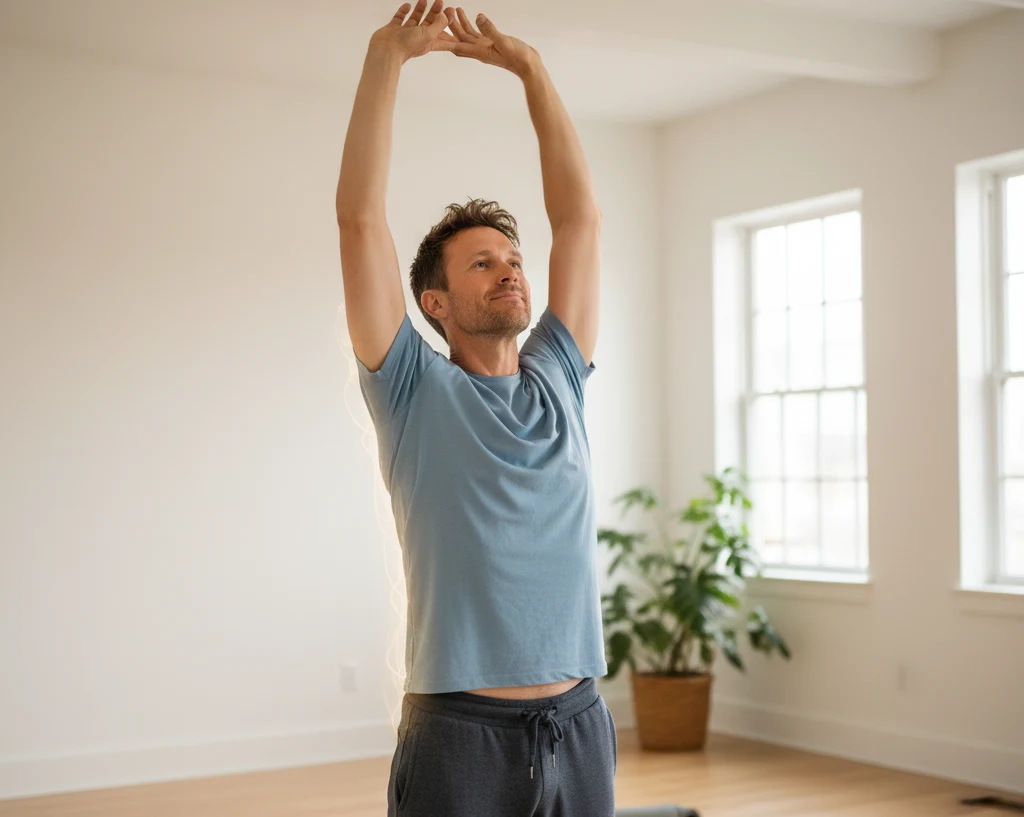
You know that feeling… hunched over a desk or stuck in a car for too long… That deep, instinctual need to reach your arms overhead, arch your back, and let out a satisfying sigh…
That moment of release feels good, but have you ever wondered what’s actually happening inside your body?
A simple stretch is far more than just a mechanical lengthening of a muscle. It’s a profound conversation with your nervous system, a way to generate your own healing energy, and one of the most powerful tools you have to shift your entire state of being.
An Electrical Conversation
We tend to think of stretching as a simple act of pulling a tight muscle, like an elastic band. The reality is much more intelligent. Your muscles and the connective tissues around them are filled with tiny, sophisticated sensors that are in constant communication with your brain.
When you ease into a stretch, two key types of these sensors get to work:
- Muscle Spindles: These sensors detect how far and how fast a muscle is being stretched. If you stretch too quickly, they send an alarm signal to your brain telling the muscle to contract to protect itself. This is why slow, mindful stretching is so effective.
- Golgi Tendon Organs (GTOs): These sensors measure tension. When you hold a gentle stretch for about 30 seconds, the GTOs send a new signal to your brain that essentially says, “All clear! The tension is safe.” In response, your brain sends a message back telling the muscle it’s okay to relax and lengthen.
This is the “aaah” moment, that sweet feeling of letting go. It’s not you forcing the muscle to release; it’s you creating the right conditions for your nervous system to give the muscle permission to do so. It’s a conversation, not a command.
Your Living Electrical Fabric
Beyond the muscles, your entire body is wrapped in a web of connective tissue called fascia. Think of it as a single, continuous bodysuit that runs from the top of your head to the soles of your feet. This living fabric is where much of the magic happens.
Your fascia has an incredible property called piezoelectricity. It’s a simple concept with profound implications: when you squeeze or stretch this tissue, it generates a tiny electrical charge.
This isn’t just a weird biological quirk; it’s a fundamental healing mechanism. These small electrical currents are thought to signal to your cells to initiate repair and reduce inflammation. When you hold a yoga pose, you are literally generating localised, therapeutic electrical fields throughout your body.
So when you feel “stuck” or “blocked,” and a good stretch makes you feel “energised” and “flowing” again, that’s not just in your head. You are actively stimulating your body’s own internal electrical system, encouraging communication and healing at a cellular level.
Flipping the Switch from ‘Stress’ to ‘Rest’
Perhaps the most important thing stretching does is give us a direct way to regulate our nervous system. Most of us spend our days running on the sympathetic nervous system, our “fight or flight” accelerator pedal. Stretching, especially when paired with slow, deep breathing, is the key to hitting the brakes.
Deep stretches, gentle twists, and forward folds all stimulate the vagus nerve, the main superhighway of your parasympathetic “rest and digest” system. Activating this nerve sends a powerful signal to your entire body to calm down.
This stimulation triggers a cascade of real, physiological changes:
- Your heart rate slows.
- Your blood pressure drops.
- Your digestive system is gently activated.
- Your brain releases acetylcholine, a neurotransmitter that promotes calmness and focus.
This is why you can walk into a yoga class feeling frazzled and walk out feeling grounded and serene. You’ve used conscious movement to flip the master switch of your nervous system, guiding yourself out of a state of chronic stress and into one of deep restoration.
Stretching is not a passive activity. It’s an act of conscious self-regulation. It’s a reminder that you have the power to change how you feel, not just in your muscles, but in your mind and your entire nervous system, one deep breath and one satisfying stretch at a time.
Happy stretching!
Jon
Leave a Reply